
7 Best Reasons
Why Your Metal Workshop Needs a Refrigerant Handheld Laser Welder
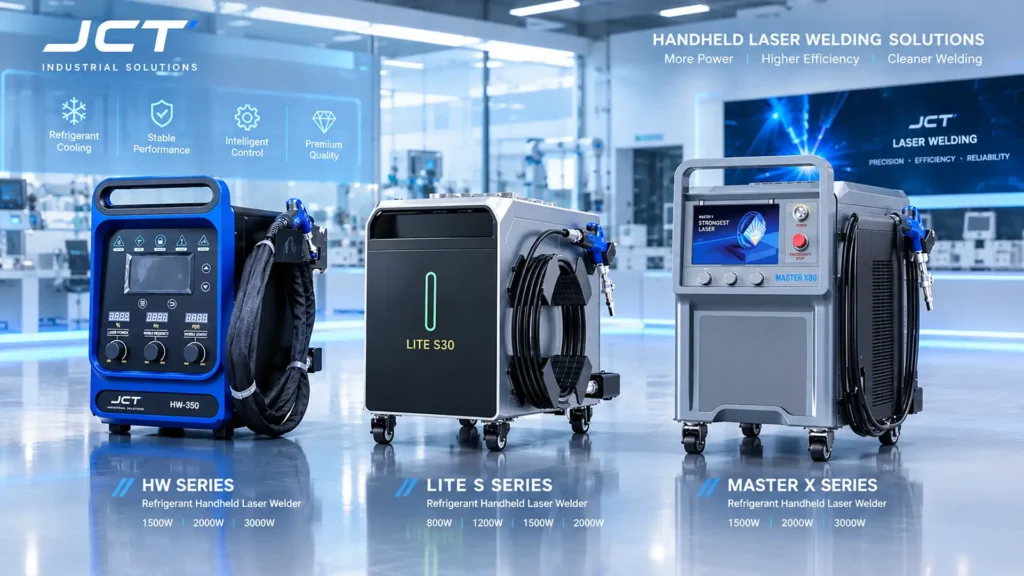
When operating a metal fabrication workshop, dealing with equipment downtime and high operational costs can severely delay your projects. If you are looking to upgrade your production line with a reliable refrigerant handheld laser welder, understanding its benefits and the reasons why you need it, is essential. This guide covers everything your engineering team needs to know to maximize efficiency and avoid costly errors.
What Is Refrigerant Direct Cooling Technology?
To understand the revolutionary breakthrough of refrigerant handheld laser welders, you must first examine their structural foundation. Traditional laser systems rely heavily on external water chillers to dissipate heat from laser sources and optical lenses. However, this method has inherent flaws: bulky tanks, scale buildup in pipelines, freezing risks in winter, and frequent overheating alerts in summer.
dual-circuit refrigerant direct cooling system completely transforms this dynamic ⬇️:
1.Closed-Loop Refrigeration Cycle:
High-efficiency refrigerant circulates directly through high-precision thermal exchange blocks, matching the precise closed-loop climate control found in advanced industrial cooling units.
2.Zero Water & No Anti-Freeze Needed
Workshops no longer need to manage pure water refills, scale scrubbing, or anti-freeze chemicals, completely eliminating short-circuit risks caused by leaks or clogged pipes.
3.All-Weather Wide-Temperature Adaptation
The system maintains stable optical output in extreme workshop environments ranging from -30°C to 60°C, performing reliably in freezing winters or high-heat tropical climates.
Traditional Water Cooling vsRefrigerant Direct Cooling
| Comparison Metric | Traditional Water-Cooked Laser Welder | Refrigerant Laser Welder) |
|---|---|---|
| Start-Up Preparation | Requires water pre-heating/cooling; restricted by ambient temperature. | Instant Start-Up, zero waiting time. |
| Daily Maintenance | Requires frequent water replacement, scale flushing, and anti-freezing checks. | Zero Daily Maintenance, saving time and labor. |
| Environmental Tolerance | Prone to freezing or overheating alarms; high operational restrictions. | -30°C to 60°C all-weather operation, immune to extreme climates. |
| Portability & Footprint | Bulky external water tanks make repositioning difficult. | Integrated, lightweight design for effortless mobility across workshop bays. |
| Optical Lens Lifespan | Vulnerable to water quality fluctuations and thermal stress. | Enhanced by wind-escape airflow design, extending lens life by 30%. |
Increasing the power of a handheld laser to 6,000W presents significant thermal management and optical challenges. To ensure the device can operate around the clock in harsh industrial environments without overheating or component degradation, our engineering team has introduced several patented technological innovations:
Why Refrigerant Laser Welders Are the Ultimate Efficiency Multipliers for Sheet Metal Fabrication?
For workshops processing stainless steel, aluminum, galvanized sheets, and copper, the ultimate KPIs are weld quality and travel speed. Refrigerant handheld laser welders have been proved by global clients across industrial markets due to robust engineering breakthroughs:
- Small-Core Technology: Advanced beam shaping delivers higher energy density. You achieve deeper weld penetration at lower electrical inputs across 1mm to 10mm materials.
- STR-K20 Lightweight Torch: Weighing only 617g with 360-degree anti-torsion armored cabling, operators experience zero arm fatigue during 10-hour shifts.
- Smart Self-Check & Process Library: Built with 30+ pre-programmed industrial process packages, operators adjust parameters via rotary knobs and touch screens instantly—achieving true plug-and-play capability.
Choosing the right refrigerant handheld laser welder is the key to scaling your manufacturing output. By partnering with a direct source factory like JCT, you secure robust equipment without inflated markups.