7 Essential Basics to Understand Before Buying Your First Environmental Test Chamber
Investing in your first industrial environmental test chamber is a major capital milestone for any R&D lab, quality control department, or manufacturing plant. Whether you are validating automotive electronics, aerospace components, or consumer plastics, subjecting products into simulated temperature and humidity extremes is non-negotiable. However, a common pitfall for first-time buyers is getting trapped by surface-level specifications—such as nominal temperature ranges—while ignoring critical engineering fundamentals like thermal change rates, refrigeration compressor architectures, and true total cost of ownership (TCO). If your engineering team is preparing to evaluate and purchase a reliable testing system, here are the 7 essential basics you must understand before signing a purchase order.
1. Temperature and Humidity Operating Envelopes
A chamber’s capability is defined by its operational envelope, not just its extreme limits. Buyers often assume a machine that reaches -40°C can maintain precise humidity at 85°C simultaneously.
True evaluation requires reviewing the psychrometric performance chart. Ensure the system maintains stable control within your exact testing profile boundaries without suffering from compressor overload, frosting on evaporator coils, or erratic dew point fluctuations.
2. Refrigeration Architecture
The heart of any thermal chamber is its cooling mechanism. Choosing the wrong refrigeration loop results in slow pull-down rates and excessive energy waste.
Single-stage mechanical compression works well for moderate temperatures down to roughly -20°C or -40°C. For deep cryogenic testing (reaching -70°C or lower), a dual-stage cascading refrigeration system using high-grade compressors (such as Bitzer or Copeland) is mandatory to deliver rapid, reliable thermal shock and pull-down performance.
3. Thermal Change Rate
Pull-down and ramp rates dictate how quickly you can simulate real-world thermal stress. Cheaply built chambers suffer from sluggish temperature transitions.
Calculate your specimen’s thermal mass (heat load) before selecting a chamber. Standard testing requires 1°C/min to 3°C/min linear ramps, while aggressive accelerated life testing (ALT) demands specialized high-rate chambers capable of 5°C/min to 15°C/min, backed by proportional-integral-derivative (PID) heating and cooling algorithms.
4. Workspace Sizing and Airflow Fluid Dynamics
Squeezing a large device into a small chamber or buying an oversized unit for tiny samples introduces severe temperature gradients.
your test specimen should occupy no more than 20% to 30% of the internal workspace volume to maintain proper airflow. Look for horizontal or vertical forced-air circulation systems that ensure uniform temperature and humidity distribution across all corners of the test space.
5. Water Quality and Humidity Generation
Humidity chambers fail most frequently due to scaling, clogged water lines, and poor steam generator maintenance.
Understand how humidity is generated. Stainless steel evaporative steam humidification systems require strict water purity (typically deionized or reverse osmosis water). Evaluating internal reservoir drainage, auto-fill mechanisms, and accessible cleaning ports prevents premature heater burnout and sensor drift.
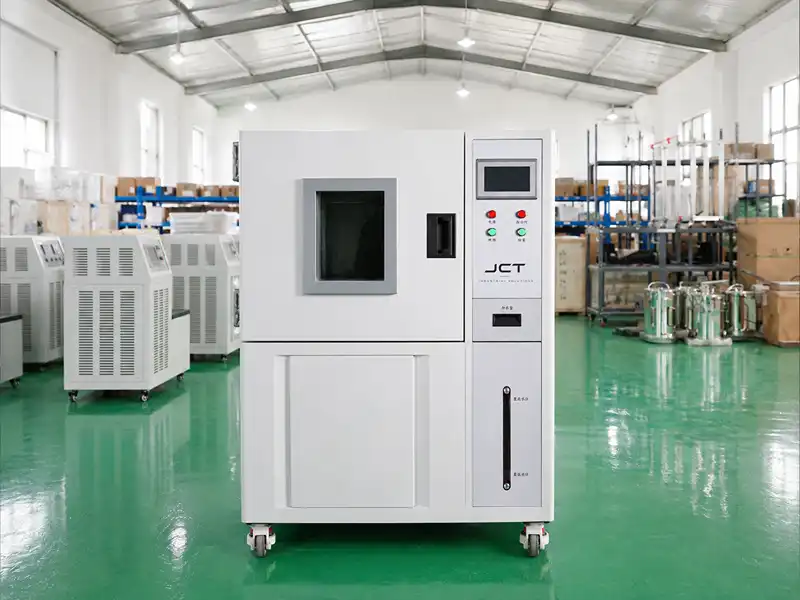
6. Controller Usability and Data Logging Compliance
An overly complex or closed-source control system creates a massive operational bottleneck for lab technicians and prevents proper quality tracking.
Insist on programmable touch-screen controllers that offer intuitive multi-segment profiling, Ethernet/Wi-Fi connectivity, and USB data export. Ensure the system integrates smoothly with your facility’s data auditing requirements, allowing real-time logging of temperature, humidity, and fault alarms.
7. Total Cost of Ownership
The purchase price is only the tip of the iceberg. Daily power consumption, water usage, and preventive maintenance dictate long-term operational expenses.
Calculate your facility’s utility preparedness—including peak electrical load, circuit breaker ratings, compressed air supply, and floor load-bearing capacity. Choosing energy-efficient electronic expansion valves and high-grade insulation panels drastically lowers long-term utility overhead.
Conclusion
Purchasing your first environmental test chamber is a foundational decision that impacts product reliability and laboratory throughput. By mastering these 7 technical basics—ranging from refrigeration architectures and thermal change rates to airflow dynamics and TCO calculations—engineering managers can eliminate costly procurement mistakes. If you still don’t know how to evaluate your testing standards, calculate chamber capacities, or select the optimal configuration for your specific laboratory layout, exploring direct-factory manufacturing solutions from specialized industrial providers like JCT offers a clear, transparent pathway to custom engineering support, robust component selection, and direct wholesale value.